
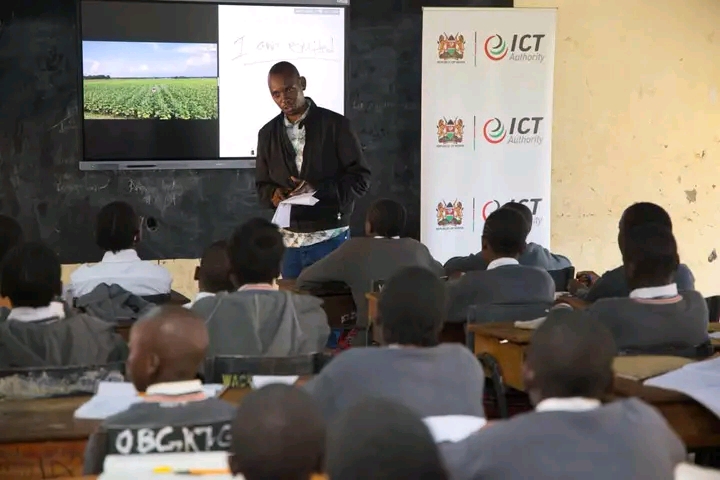
ICT Authority officials address learners and teachers at Webuye ACK
ICT Authority Accelerates Digital Learning Milestone in Bungoma.The Information and Communications Technology (ICT) Authority has again affirmed its role in propelling the Government’s digital transformation agenda in the education sector in Kenya. This was emphasised as the Digital Literacy Programme (DLP) is rolled out at Webuye ACK Junior School in Webuye East Constituency, Bungoma County. The government wants to integrate 100% ICT into public schools, making sure that the students acquire the tools and technology that is essential in this modern age.The project is being led by the ICT Authority Chief Executive Officer Jessy Maruti, and it aims to provide key digital learning infrastructure to public Junior Schools.

Ict Officials demonstrating to learners
The program will be designed to be a strong facilitator of the Competency Based Curriculum (CBC) through the introduction of interactive smart boards, a reliable internet connection, and digital content. This large-scale change in education aims to make classrooms more engaging and learner-centered than the traditional ones known as “learning factories”.This digital transformation is massive in scale, with over 20,000 public junior schools to be reached nationwide. The first phase of the rollout is already underway with 10,384 schools across the country having received their digital kits.

ICT Authority officials engage learners and teachers during the Digital Literacy Programme rollout at Webuye ACK Junior School.
All beneficiaries schools have been provided with Interactive Smart Board and Laptops which is expected to greatly improve the teaching and learning process in the schools and lead to improved learning outcomes.The distribution will be making huge fruits in the region, especially in the Western region where more than 1,300 schools are benefitting. These institutions, of which 31 are schools in Webuye East, make up 393 of all such institutions in Bungoma County. “This strategic distribution to the rural areas reflects the government’s approach towards equity in education, providing every learner with the right digital tools, irrespective of their geographical location,” said CEO Jessy Maruti.

A government vehicle at the Digital Literacy Programme rollout
The Ministry of Information, Communications, and The Digital Economy is working hard to build a solid network infrastructure to make these devices sustainable. The schools are being linked to high-speed Internet via the ICT Authority under the ambitious national fibre optic expansion programme of 100,000 km. Moreover, digital content for Grades 7 and 8 has already been prepared with the support of the Kenya Institute of Curriculum Development (KICD), whereas the content for Grade 9 is being digitized. More than 62,000 teachers have also been carefully trained to implement these tools in their regular teaching with proficiency, to address the skill shortage.The event in Webuye ACK Junior School was a colorful presentation on community and multi-agency cooperation which was attended by high level national and local officials.
The principals were Dr. Oliver Pyoko, Deputy Director, ICT Authority and Galgallo Fayo, Deputy Director, ICT Authority, Assistant County Commissioner Alex Nganyi and Sub-County Education Director Linda Serete among others. The local security units provided a robust guarantee of safety of the equipment and the local CDF office and leadership, including Fund Manager Dancan Kodii and MP Representative Ben Kakalukha, made an assurance to provide infrastructure support going forward.In the end, the Digital Literacy Programme is a crucial part of the Digital Superhighway in Kenya. The project, which was introduced under the World Bank-funded and World Bank-strategically supported “Kenya Digital Economy Acceleration Project” (KDEAP), helps to bring local talent closer to global standards. Kenya is cultivating a generation that is technologically literate, starting from primary and junior school, and is well-positioned to meet the future needs of the workforce.